
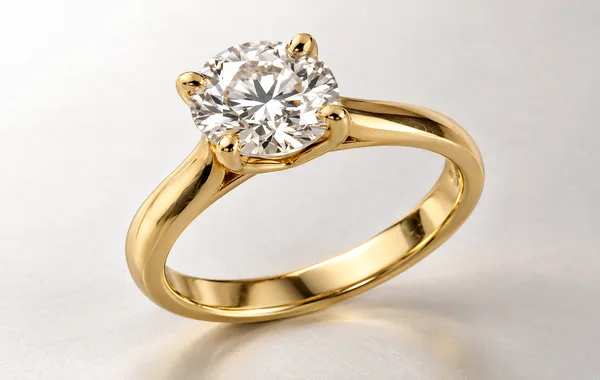
In commercial e-commerce photography, no product category presents greater technical difficulty or carries higher financial stakes than fine jewelry. An engagement ring, diamond necklace, or luxury chronograph represents a high-consideration purchase where consumers scrutinize product images under 300% zoom magnification before committing thousands of dollars.
Photographing jewelry under high-magnification macro lenses (such as 100mm or 180mm macro optics) reveals every physical imperfection: microscopic casting pores, micro-scratches from studio handling, atmospheric dust motes, and complex multi-faceted reflections of studio diffusers. At the same time, jewelry is notoriously easy to ruin in post-production: amateur retouchers frequently over-blur precious metals until solid gold looks like yellow plastic, and paste synthetic starburst lens flares over diamonds that look fake to discerning buyers.
Professional jewelry retouching requires a delicate balance of technical precision, material physics, and restraint. Use this comprehensive quality checklist to evaluate and audit retouching deliverables across diamonds, precious metals, and colored gemstones.
1. Diamonds & Facet Clarity: Natural Fire vs. Synthetic Sparkle
Diamonds are cut according to strict optical geometry (such as the 57 facets of a round brilliant cut) designed to reflect and refract light internally. Professional retouching enhances natural brilliance without inventing false geometry:
| Inspection Zone | Professional Quality Standard | Common Retouching Error |
|---|---|---|
| Facet Junction Sharpness | Facet junctions (edges where two facet planes meet) remain razor-sharp and geometrically straight. | Over-using the Smudge or Blur tool rounds off facet edges, making the diamond look like molded glass. |
| Internal Contrast & “Fire” | High contrast between bright white brilliance and deep dark pavilion reflections (scintillation). | Flattens the stone with global exposure boosts, washing out internal contrast into a milky gray haze. |
| Authentic Sparkle | Specular highlights are sharpened naturally from the camera’s optical sensor data. | Synthetic Starburst Stamps: Pasting artificial 4-point or 6-point sparkle brushes over the table. |
| Girdle & Prong Definition | The girdle edge is clean; prongs are polished without blurring the diamond boundary beneath them. | Vector paths accidentally chop into diamond prongs, creating flat or clipped metal tips. |
2. Precious Metals: Retaining True Metallic Luster (Gold, Platinum, Silver)
Precious metals behave completely differently from matte or textured materials. Polished metals do not have an inherent diffuse color; they are mirrors that reflect their environment:
- The “Plastic Metal” Pitfall: Amateur editors frequently attempt to clean scratches by using the Clone Stamp tool set to Normal, or by brushing flat solid color over the metal. This destroys the specular gradient, transforming 18k yellow gold into flat yellow plastic.
- The Frequency Separation Solution: Master jewelry retouchers employ Frequency Separation. On the high-frequency texture layer, they remove microscopic casting pits, lint, and hairline scratches using the Healing Brush. On the low-frequency color layer, they smooth specular lighting gradients while preserving the authentic metallic falloff from bright highlight to deep core reflection.
- Preserving Brushed & Satin Finishes: For satin-finished platinum or brushed titanium, high-frequency texture must be preserved 100%. Removing the texture destroys the designer’s intended surface finish.
3. Colored Gemstones: Colorimetric Accuracy & Refraction (Rubies, Sapphires, Emeralds)
Unlike diamonds, colored gemstones carry significant value in their hue, tone, and saturation. A slight color error in post-production can lead to catastrophic customer return rates:
- Truthful Saturation vs. Unrealistic Vibrance: Never apply global Vibrance or Saturation adjustments to colored gemstone images. An uncalibrated saturation boost turns a genuine Ceylon sapphire into unnatural neon blue. Color adjustments must be calibrated against physical master swatches under D50 5000K daylight simulation.
- Preserving Internal Inclusions & Facet Depth: Natural gemstones feature subtle optical characteristics (such as slight color zoning or microscopic silk in rubies). Erasing all internal texture makes natural gemstones look like cheap lab-created cubic zirconia.
- Preventing Black Pavilion Extinction: In deep-colored stones, poor lighting can cause the pavilion facets to appear completely black (extinction). Retouchers use non-destructive Curves masks to lift shadow detail in the lower pavilion facets without blowing out the saturated table color.
4. Grounding & Shadow Physics: Avoiding “Floating” Jewelry
Because jewelry is shot on macro tables with custom risers or clear acrylic props, placing the isolated piece onto a pure white background (RGB 255, 255, 255) requires realistic grounding:
- The Floating Ring Defect: Placing an engagement ring onto solid white with zero shadow makes it appear to float disconnected in empty space.
- The Dual Grounding Technique:
- Contact Shadow: A dark, concentrated shadow placed directly beneath the base of the band where metal touches the surface.
- Mirror Reflection: A subtle, elegant reflection of the bottom 20% of the ring. The reflection must feature a linear opacity gradient fading from 20% opacity to 0% over a 50-pixel distance, accompanied by a progressive vertical blur simulating natural surface falloff.
5. The Master Jewelry Pre-Flight Inspection Checklist
Before publishing or approving luxury jewelry deliverables, execute this rigorous inspection sequence at 200% magnification:
- [ ] Prong & Clasp Integrity: Inspect every individual prong holding the center stone and pavé halo. Prongs must be smooth, symmetrical, and free of vector clipping bites.
- [ ] Dust & Scuff Free: Verify zero visible dust fibers on the metal band, stone table, or pavilion facets under high zoom.
- [ ] No Synthetic Lens Flares: Confirm zero artificial starburst filters or digital sparkle brushes were applied.
- [ ] Metallic Gradient Intact: Check that gold or platinum surfaces display smooth specular falloff rather than flat solid color.
- [ ] Pure White Canvas: Sample the outer canvas corners with the Photoshop Eyedropper to confirm exactly RGB (255, 255, 255).
- [ ] Realistic Surface Reflection: Confirm the piece features a subtle, grounded contact shadow or gradient mirror reflection.
Luxury Jewelry Retouching with Authentic Macro Precision
ClipPathPro’s dedicated master jewelry atelier specializes in high-magnification retouching for global luxury retailers and fine jewelers. We preserve diamond fire, clean precious metals using non-destructive frequency separation, and deliver catalog perfection within guaranteed 24-hour turnarounds.
Explore Professional Jewellery Retouch Services Test 3 Jewelry Images Free Today →
Frequently Asked Questions
Why do artificial diamond sparkles and starburst filters harm luxury jewelry sales?
Artificial lens flares and sparkle stamps obscure diamond cut clarity and make fine jewelry appear cheap and synthetic. Discerning luxury consumers expect to see authentic table facets, crisp facet junctions, and natural internal light dispersion.
How do professional retouchers clean gold and platinum without making it look like plastic?
Retouchers use Frequency Separation to separate micro-scratches and dust (high-frequency texture layer) from the specular light gradient (low-frequency color/tone layer). This allows scratches to be eliminated while preserving the natural metallic sheen.
How is accurate color maintained on colored gemstones like rubies, sapphires, and emeralds?
Gemstone color must be calibrated using calibrated spectrophotometers and reference swatches under D50 daylight standards. Retouchers never apply global hue shifts; they selectively mask the gemstone to preserve internal light refractions and pavilion facet depth.
What is the industry standard for grounding jewelry on pure white backdrops?
Jewelry should never float ungrounded on a flat white canvas. Professional deliverables include either an authentic soft contact shadow or a subtle, 15% to 20% opacity mirror reflection that fades out within 100 pixels beneath the piece.