
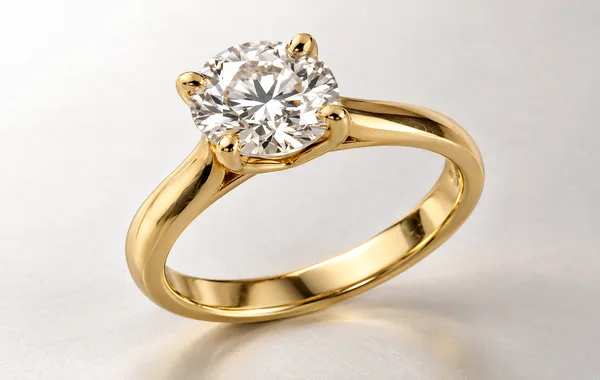
Macro jewelry photography is the most unforgiving discipline in commercial post-production. At five-times life-size magnification, microscopic dust motes resemble boulders, polished platinum mirrors studio light stands, and high-clarity diamonds photograph as dull, lifeless gray glass.
Yet solving these physical optical challenges requires far more than generic blur filters or contrast sliders. High-ticket e-commerce brands and luxury catalog houses require an expert luxury jewelry photo retouching diamond reflections workflow: a specialized prepress process that balances focus-stacked macro sharpness, cleans metal reflections without flattening curvature, and restores fire and brilliance to gemstone facets.
What Is Luxury Jewelry Photo Retouching?
Luxury Jewelry Retouching (Operational Definition)
Commercial luxury jewelry photo retouching is an advanced prepress technique that synthesizes focus-stacked macro frames, cleans polished precious metal reflections, and restores brilliance to diamond and colored gemstone facets. Working at 300% to 500% zoom, retouchers eliminate casting porosity and micro-dust while preserving crisp edge specular highlights and natural gold undertones.
This technical guide details the macro optical physics of jewelry capture, outlines the four precious metal reflection categories, explains the step-by-step diamond facet restoration protocol, and provides the production specifications required to protect luxury brand margins.
The Macro Optical Challenge: Why Raw Jewelry Photos Never Look Sellable
Even when captured with $10,000 medium format cameras, 120mm macro lenses, and specialized jewelry light cones, raw jewelry photographs emerge from the sensor with severe optical deficiencies:
1. The Razor-Thin Depth of Field Barrier
In macro photography at 1:1 or 2:1 magnification, depth of field shrinks to fractions of a millimeter (often less than 0.5mm), even when stopping down to $f/11$ or $f/16$. Stopping down further to $f/22$ triggers severe optical diffraction, softening fine prong details and diamond facet junctions. To achieve front-to-back sharpness on an engagement ring, studios must capture 15 to 40 focus-bracketed frames that require specialized composite focus-stacking in post-production.
2. The “Carnival Mirror” Metal Reflection Trap
Polished 18K yellow gold, rhodium-plated white gold, and platinum are optical mirrors with near-100% specular reflectance. The metal surfaces reflect camera lenses, tripod legs, studio baffles, and even the photographer’s dark clothing. Removing these distracting reflections while preserving the metal’s cylindrical curvature and crisp specular highlights requires hand-crafted vector path painting.
3. Total Internal Refraction Extinction in Gemstones
Diamonds are cut to precise mathematical angles (e.g., the 57-facet Tolkowsky Ideal Brilliant cut) designed to reflect light entering the crown back out to the viewer. When photographed inside light tents or softbox enclosures, light enters from diffuse angles, causing total internal reflection to fail. The diamond’s table facet renders as a dark, murky void, while dispersion (the fiery rainbow scintillation of red, green, and violet light) is completely neutralized.
Explore High-End Jewelry Retouching Services
See before-and-after macro comparisons of diamond ring polishing, gemstone color calibration, and focus-stacked composite blending.
The 4 Precious Metal Surface Classes and How to Retouch Them
Every precious metal alloy reflects light according to distinct physical properties. Applying a uniform retouching formula across different metals destroys natural material authenticity:
| Precious Metal Surface | Optical Characteristic | Primary Retouching Pitfall | Atelier Prepress Solution |
|---|---|---|---|
| Rhodium-Plated White Gold | Ultra-bright cool white specular sheen with blue-gray undertones | Desaturating metal into flat, lifeless neutral gray | Preserve subtle 3% to 5% cool cyan-blue tint; paint crisp 1-pixel edge highlights. |
| 14K / 18K Yellow Gold | Warm, rich amber-gold specular reflectance | Turning metal brassy, orange, or greenish in shadows | Selective Color calibration to Pantone 136 C; retain warm amber core with neutral white specular peaks. |
| 18K Rose Gold | Copper-alloyed warm pinkish-gold hue | Shifting toward bronze or generic yellow gold in highlights | Isolate red-magenta chrominance channels; ensure pink undertones remain consistent across catalog angles. |
| Brushed / Satin Platinum | Dense, directional anisotropic light diffusion | Smoothing satin texture into artificial chrome polish | Frequency separation to clean surface blemishes while preserving directional linear brush grain. |
By treating each metal alloy as a unique optical material, our atelier maintains the tactile weight and luxury value of the physical jewelry piece.
The 6-Step Diamond Facet Restoration SOP
When prospective buyers zoom in on a $15,000 diamond solitaire online, they expect to see crisp facet geometry, intense scintillation, and zero internal haze. Our senior jewelry colorists execute the following six-step facet polishing protocol:
Step 1: Multi-Path Vector Facet Isolation
Using the Photoshop Pen Tool at 400% zoom, retouchers draw precise vector clipping paths around the stone’s perimeter, the table facet, star facets, kite facets, and pavilion lower girdle facets. Each facet group is saved as an independent alpha channel.
Step 2: Micro-Inclusion and Dust Cleanup
Using microscopic healing brushes, retouchers eliminate external dust particles and lint while strictly preserving genuine internal diamond inclusions (feathers, crystals, clouds) that match the stone’s certified GIA/IGI grading report. Over-clearing natural inclusions on certified diamond listings constitutes consumer fraud.
Step 3: Facet Contrast and Black Reflection Elimination
Diffuse studio lighting often reflects the dark camera lens directly into the diamond’s central table, creating an unsightly black hole. Retouchers map gradient reflections onto individual facet layers, lifting dark dead zones to luminous white and silvery-gray tones matching adjacent facets.
Step 4: Prismatic Dispersion and Scintillation Enhancement
Natural diamonds split white light into spectral fire (red, orange, green, and violet flashes). Retouchers selectively enhance micro-color dispersion along facet junctions, restoring vivid spectral sparkle without creating garish chromatic aberration.
Step 5: Girdle and Prong Contact Splicing
Prongs holding the gemstone cast heavy green, yellow, or dark shadows onto the underlying diamond pavilion. Using delicate dodge and burn curves, colorists neutralize prong color casts, restoring transparency and light flow through the setting.
Step 6: Edge Specular Sharpening
Facet junction lines must be razor-sharp. Using high-pass filters applied exclusively through vector facet masks, retouchers sharpen facet boundaries without introducing noise into the diamond’s internal glassy planes.
Micro-Pavé Setting Retouching Protocol: Balancing 50+ Accent Stones
While a large center diamond demands individual facet painting, high-end bridal and red-carpet jewelry frequently features pavé and micro-pavé settings containing dozens of stones under 1.5mm in diameter. Retouching micro-pavé settings presents distinct operational challenges:
1. Shared Prong Shadow and Oxidation Correction
In micro-pavé settings, diamonds are held by tiny beads of metal pushed up from the mounting. Under macro illumination, deep black shadows accumulate between adjacent beads, giving the ring band a dirty, unpolished appearance. Retouchers build custom multi-tier curves that lift inter-bead shadow density while maintaining contrast on the bead prongs, restoring an immaculate, continuous, flawless pavé surface.
2. Eliminating Uneven Scintillation and “Dead” Accent Stones
Due to minute variations in stone setting angles, five or six diamonds across a 40-stone halo will reflect light away from the camera, rendering as dark gray or brown voids next to blazing white stones. Retouchers sample specular highlights and dispersion flashes from neighboring stones, rebuilding illumination across dark accent stones to ensure optical harmony across the entire setting.
3. Micro-Bead Highlight Reconstruction
Polished metal prongs that secure micro-pavé diamonds are often less than 0.3mm wide. Retouchers hand-paint 1-pixel specular highlight points on every individual bead using a pure white hard round brush at 100% opacity, creating the signature liquid-diamond brilliance demanded by luxury fine jewelry houses.
Prepress Print vs. E-Commerce Display Standards for Luxury Jewelry
Luxury jewelry brands frequently utilize identical photographic assets across both physical high-gloss print lookbooks (Vogue, Harper’s Bazaar, brand catalogs) and high-speed e-commerce storefronts. Balancing both mediums requires maintaining a dual-pipeline master asset architecture:
| Technical Specification | E-Commerce Web & Mobile Storefront | Luxury Commercial Offset Print Lookbook |
|---|---|---|
| Color Gamut & Space | sRGB IEC61966-2.1 (8-bit per channel) | Adobe RGB (1998) or ProPhoto RGB (16-bit depth) |
| Print Profile Conversion | Not applicable (RGB direct display) | FOGRA39 / FOGRA51 or GRACoL 2006 Coated CMYK |
| Total Ink Limit (TAC) | No ink restrictions (RGB 0–255 scale) | Strictly capped between 280% and 300% to prevent ink pooling on gloss paper |
| Sharpening Radius | 0.3 to 0.6 px (Optimized for Apple Retina & 4K screens) | 1.0 to 1.5 px (Compensates for prepress dot gain on 175–200 LPI screens) |
| Master Archive Format | Compressed WebP / PNG-24 / JPEG | Uncompressed 16-bit Layered TIFF / PSD with embedded vector paths |
Our colorists preserve all retouching layers, alpha channels, and vector clipping paths in 16-bit master PSD archives, allowing instant conversion to either high-resolution CMYK prepress or lightweight mobile web deliverables without re-editing.
Focus Stacking Ingestion: Merging 20+ Macro Slices with Zero Ghosting
In high-end commercial jewelry campaigns, a single ring requires capturing a focus bracket sequence of 20 to 40 raw frames at incremental focal distances using automated motorized macro rails (such as Cognisys StackShot or Novoflex Castel-Micro).
Automated focus stacking software (Helicon Focus, Zerene Stacker, or Photoshop Auto-Blend) frequently introduces optical artifacts that require skilled manual retoucher intervention:
| Stacking Artifact | Optical Root Cause | Manual Atelier Correction Protocol |
|---|---|---|
| Halo Ghosting Along Prongs | Out-of-focus background frames blurring over in-focus foreground prongs | Manual layer mask painting from sharpest raw frame to restore clean prong boundaries. |
| Mottled Noise in Metal Bands | Depth-map stacking algorithms averaging soft blur noise | Composite clean metal surfaces from single sharp base frames; apply smooth vector gradations. |
| Double Facet Edges in Diamonds | Lens focus breathing causing slight magnification shifts between slices | Perspective alignment correction followed by selective manual facet stamping from prime focus slices. |
By combining automated stacking algorithms with manual brush retouching on layered PSDs, ClipPathPro delivers edge-to-edge sharpness across complex multi-stone pavé settings.
Colored Gemstone Color Calibration: Emeralds, Rubies & Sapphires
While diamonds require neutral light balance, colored gemstones present extreme color gamut challenges in prepress production:
- Colombian & Zambian Emeralds: Highly saturated bluish-green tones often exceed standard sRGB color gamuts, causing emeralds to render as muddy dark green. Colorists soft-proof in Adobe RGB 1998, using selective selective cyan and yellow curves to preserve the stone’s characteristic internal “jardin” inclusions and glowing transparency.
- Burmese Rubies: High-grade “pigeon’s blood” rubies contain strong natural red fluorescence excited by UV radiation. Raw sensors frequently overexpose the red channel, blowing out facet detail. Retouchers pull back red channel clipping while boosting underlying crimson contrast to maintain deep gemstone richness.
- Ceylon & Kashmir Sapphires: Intense cornflower blues frequently shift toward violet or purple under studio strobe lighting due to sensor blue-channel sensitivity. Colorists calibrate sapphire hues against GIA color grading reference cards to maintain authentic velvet-blue saturation.
For more details on how volume rate cards scale across commercial jewelry editing tiers, explore our complete breakdown of product photo retouching rates per image.
Prepress Packaging & High-Gloss Catalog Ink Limits for Fine Jewelry
Translating an exquisite, backlit RGB jewelry capture onto physical coated paper stock is one of the most demanding technical disciplines in commercial prepress production. On an OLED smartphone screen or high-brightness desktop monitor, diamonds radiate light outward because pixels emit their own luminance. On high-gloss auction catalog paper, light is purely reflective. Without specialized prepress separation, precious white gold bands print as lifeless gray smears, and dark shadow crevices beneath diamond prongs pool into muddy ink blots that scuff on bindery conveyor belts.
To preserve diamond brilliance and crisp metallic reflections in luxury print catalogs (such as Sotheby’s, Christie’s, or Cartier fine print lookbooks), retouchers and prepress colorists enforce strict color management thresholds:
- Total Area Coverage (TAC) / Total Ink Limit (TIL) Management: Standard high-speed sheetfed offset presses printing on Grade 1 coated gloss stock typically mandate a maximum ink coverage limit between 300% and 320% (GRACoL 2013 / ISO 12647-2). In uncorrected macro jewelry files, the deep shadow cavities beneath pavé settings frequently register 380% to 400% TAC across Cyan, Magenta, Yellow, and Black plates. Colorists apply heavy Gray Component Replacement (GCR) and Under-Color Removal (UCR) curves, transferring heavy CMY color builds into pure Black (K) channel density. This prevents wet ink pooling, eliminates press drying delays, and maintains razor-sharp prong contrast.
- Skeletal Black Plate vs. Neutral Gray Balance: Polished platinum, white gold, and titanium jewelry possess neutral reflectance with microscopic specular pings. If rendered using a heavy four-color black build, subtle mechanical drift on a multi-unit commercial printing press will cause the precious metal to shift noticeably toward green, magenta, or yellow midway through a 50,000-copy catalog run. Prepress retouchers calibrate the neutral metal tone using a balanced skeletal black plate supplemented by clean cyan micro-curves, guaranteeing that neutral platinum stays cool and pure across every catalog page.
- Specular Pin-Highlight Preservation (The 0% Plate Dot): Diamond facet reflections contain pin-sharp specular highlights that must read as pure paper white (RGB 255, 255, 255). Many automated prepress curves introduce an artificial minimum press dot (typically 2% to 3% dot gain) to avoid harsh dot break. If applied across a diamond’s table and kite facets, this minimum dot turns sparkling white brilliance into a dingy, light gray veil. Certified jewelry retouchers isolate specular facet pings on dedicated vector alpha channels, protecting them from tone curve compression so they drop to pure 0% ink on physical press plates.
Casting Porosity vs. Precious Metal Hallmarks: The Retoucher’s Boundary Line
Every commercial jewelry post-production workflow faces an ethical, legal, and aesthetic boundary line: determining what surface imperfections must be micro-healed versus what markings must be religiously preserved.
When high-end jewelry is cast using lost-wax investment casting, microscopic surface defects inevitably appear on the raw metal:
- Gas Porosity & Pinholes: Pockets of trapped gas in molten gold or platinum produce microscopic spherical pinholes (measuring between 10 to 50 microns) along ring shanks and inside bezel cups.
- Shrinkage Cavities & Dendritic Textures: As precious metals cool and contract from liquid to solid state, irregular microscopic fissures form along thicker casting sections.
- Polishing Wheel Scratches: Even after multiple hand-polishing stages with rouge compound, high-magnification 100-megapixel medium-format macro sensors expose directional hairline scratches and micro-abrasions across mirror-polished bands.
Our senior jewelry retouchers eliminate these manufacturing artifacts using non-destructive frequency separation and micro-dodge-and-burn painting, restoring an immaculately smooth mirror finish without degrading the physical geometry or rounding sharp chamfered edges.
However, retouchers must know exactly where to stop. Meticulous commercial jewelry post-production strictly preserves all official assay purity hallmarks, maker’s sponsor marks, and diamond laser inscriptions:
- Assay Purity Stamps: Official governmental hallmarks indicating metal fineness (such as 750 for 18-karat gold, 950 for platinum, 925 for sterling silver, and regional assay office icons like the London leopard head or Birmingham anchor) must never be smoothed away or blurred. Erasing these marks in post-production compromises consumer trust and violates FTC jewelry advertising guidelines.
- GIA / IGI Diamond Girdle Inscriptions: On large certified center stones, jewelers frequently request high-resolution detail views showing the microscopic laser-engraved certification number on the diamond’s girdle. Retouchers isolate the girdle plane, optimizing micro-contrast so the microscopic inscription reads clearly without altering facet brilliance.
- Designer Maker’s Marks & Serial Numbers: Luxury brands distinguish their heritage through custom inner-shank stamps and registered serial codes. Our retouchers isolate hallmark clusters within protective vector zones, cleaning surrounding porosity while leaving stamped numerals, serif lettering, and metal displacement borders crisp and pristine.
Comparative Prepress Matrix: Luxury Diamond & Fine Jewelry Production Specifications
To help creative directors, e-commerce managers, and catalog producers specify exact deliverable parameters, our atelier maintains the following standardized prepress matrix across jewelry distribution channels:
| Distribution Channel | Target Color Space | Resolution / PPI | Clipping Path Tolerance | Diamond Contrast Curve | Shadow Isolation Method |
|---|---|---|---|---|---|
| E-Commerce Hero & Zoom (Shopify / Magento) | sRGB IEC61966-2.1 | 72 to 144 PPI (2,500px square) | 0.5px Pen Tool Vector Inset | High-dynamic S-curve, clipped at 254 white point | Synthetic ground contact shadow on #FFFFFF |
| Fine Auction Catalog (Sotheby’s / Christie’s) | GRACoL 2013 / ISO 12647-2 CMYK | 300 to 350 PPI at 100% trim size | Zero-tolerance vector silhouette path | GCR-compensated curve, 310% TAC ceiling, 0% specular dot | Extracted soft natural ambient contact shadow |
| Luxury Digital Flagship / 8K OLED Displays | Display P3 Wide Gamut | 300 PPI (7,680 × 4,320px) | Sub-pixel bezier vector mask | Linear tone mapping preserving fire sparkle spectral dispersion | Floating soft gradient on transparent alpha background |
| 360-Degree Interactive Turntable (72 Frames) | sRGB IEC61966-2.1 WebP | 72 PPI (1,800px square) | Batch-aligned vector bounding envelope | Locked master curve across all 72 rotational frames | Locked stationary radial contact shadow |
Frequently Asked Questions About Luxury Jewelry Retouching
Can you retouch jewelry images photographed without focus stacking?
Yes. If single frames were captured, retouchers apply selective sharpening, frequency separation, and edge-contrast painting to maximize apparent depth. However, for large commercial catalog prints or zoom-enabled e-commerce listings, submitting focus-stacked brackets (15 to 30 frames) delivers vastly superior edge-to-edge clarity.
Do you remove casting porosity and scratches from precious metals?
Yes. Production jewelry pieces fresh from casting often feature microscopic pinhole porosity, polishing wheel swirl marks, and dust. Our retouchers eliminate all surface imperfections, hand-painting smooth metallic gradients while preserving authentic metal highlights and hallmark stamps.
Can you change the metal color from yellow gold to rose gold or platinum?
Yes. Using hand-drawn vector masks and custom 3D Look-Up Tables, our atelier can photograph one yellow gold ring and render identical, color-accurate rose gold, white gold, and platinum variations, saving brands thousands in sample manufacturing costs.
What turnaround times are available for high-volume jewelry drops?
Due to the meticulous detail required for macro jewelry retouching, standard turnaround is 24 to 48 hours for batches of 50 to 200 images. Dedicated client pods maintain our guaranteed 24-hour photo retouching service for agencies.
Elevate Your Jewelry Catalog to Luxury Prepress Standards
Stop losing high-ticket sales to dull diamonds and messy metal reflections. Partner with a commercial post-production atelier that treats jewelry retouching as a fine art, backed by focus-stacked composite expertise, certified color calibration, and pixel-level vector craftsmanship.
Test Our Atelier with 3 Macro Jewelry Pilot Files
Send us 3 challenging jewelry raw frames or focus-stacked brackets. We will return fully polished, color-calibrated proofs within 24 hours accompanied by an itemized volume rate card. Zero cost. Zero commitment.