
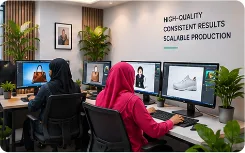
When a commercial campaign drops with two thousand raw catalog frames and a rigid client launch date, your agency cannot afford missed deadlines or sloppy cutouts. Every hour spent chasing unreturned freelancer messages or fixing stair-stepped clipping paths shrinks your project margin and damages client trust.
Yet finding a reliable 24 hour photo retouching service for agencies that handles high-volume catalog drops without sacrificing prepress vector precision remains a major operational challenge. Automated software claims instant results but leaves gray halos on dark apparel, while domestic retouching houses charge premium rush fees that wipe out agency profitability.
What Is a 24-Hour Photo Retouching SLA for Commercial Agencies?
24-Hour Agency Retouching SLA (Operational Definition)
A commercial 24-hour photo retouching SLA is a legally binding contract guaranteeing that an agency batch of 500 to 2,000+ catalog images uploaded by 6:00 PM EST is returned fully clipped, color-matched, and QA-verified by 8:00 AM EST the following morning. It operates via global time-zone arbitrage, backed by guaranteed throughput capacity, dedicated retoucher pods, and financial penalty credits for delayed delivery.
This technical guide details how commercial photography studios and high-volume creative agencies leverage time-zone arbitrage to turn around 2,000+ frames overnight, compares ingestion pipelines, analyzes defect mitigation protocols, and outlines the exact SLA provisions required to protect client campaign commitments.
The Global Time-Zone Arbitrage Model: How Overnight Turnaround Actually Works
Most creative directors assume that “overnight delivery” requires paying local artists expensive overtime rates to pull all-nighters. In commercial post-production, sustainable speed does not come from sleep-deprived artists; it comes from geographical time-zone arbitrage.
Consider the operational timeline between North America, Western Europe, and our primary production atelier in South Asia:
| Stage & Local Time | Studio Location (US EST) | Atelier Location (Dhaka / UTC+6) | Operational Workflow Actions |
|---|---|---|---|
| Phase 1: Shoot Wrap (5:30 PM EST) | Daylight shoot concludes; digital tech packages files | 4:30 AM (Next Day) — Night dispatch queue ready | Capture One session export; EIP files or high-res TIFFs staged in hot folder. |
| Phase 2: Ingestion & Task Routing (6:30 PM EST) | Agency creative team leaves the studio | 5:30 AM — Lead colorist ingests batch | Automated checksum verification; assets distributed across dedicated specialist retoucher pod. |
| Phase 3: Deep Production (9:00 PM – 4:00 AM EST) | Agency studio offline (Night) | 8:00 AM – 3:00 PM — Full daytime operational shift | Hand-drawn vector Pen Tool paths, ghost mannequin splicing, frequency separation, and color grading. |
| Phase 4: Senior QA Proofing (5:00 AM EST) | Agency studio offline (Pre-dawn) | 4:00 PM — Senior Quality Assurance review | 100% monitor proofing at 200% zoom against agency style guide; background clipping tolerance checks. |
| Phase 5: Delivery & Client Ingestion (8:00 AM EST) | Art Director opens email at studio start | 7:00 PM — End of dispatch shift | All 2,000+ files delivered in layered PSD / TIFF formats, ready for immediate client handoff. |
Because your nighttime is our daylight production window, your studio gains a continuous 24-hour production engine. You shoot all day, transfer files at wrap, and arrive the next morning to finished, client-ready assets without paying overtime or working nights.
Review Dedicated Studio Retoucher Capacity
Learn how leading e-commerce studios lease dedicated monthly retoucher pods for guaranteed overnight turnaround and fixed monthly pricing.
High-Volume Agency Throughput: Capacity by Batch Size
Turnaround commitments depend directly on volume and complexity tiers. A professional prepress atelier structures its 24-hour turnaround guarantees around four primary volume brackets:
- Emergency Rush Drops (50 to 250 Images): Turnaround in 6 to 12 hours. Ideal for same-day social campaigns, urgent PR lookbooks, or editorial drop-dead deadlines. Handled by an expedited sprint pod.
- Standard Commercial Drops (250 to 1,000 Images): Turnaround guaranteed in 24 hours. The baseline standard for seasonal e-commerce drops, apparel line sheets, and footwear catalogs.
- High-Volume Enterprise Drops (1,000 to 3,000 Images): Turnaround delivered in 24 to 36 hours (or staggered in rolling 1,000-image waves every 12 hours). Requires dedicated lead retoucher oversight and automated ingestion scripts.
- Mass Catalog Production (5,000+ Images / Week): Dedicated multi-shift retoucher pod (3 to 10 full-time equivalents). Operates on continuous ingestion pipelines with custom S3 hot folders and real-time Slack/Teams integration.
The 4 Hidden Failure Points in Agency Rush Work (And How SLAs Prevent Them)
Agencies that have experienced bad outsourcing relationships know that “fast delivery” is useless if the images are unpublishable. When rush deadlines hit unvetted freelance mills, four critical failure modes occur:
1. Automated AI Auto-Masking Halos
Under tight deadlines, rushed editors stop drawing manual vector bezier curves with the Pen Tool and rely on automated background removal algorithms or magnetic lassos. Automated tools struggle with contrast transitions, leaving 1-pixel to 3-pixel white or colored halos along dark product contours. When placed on pure white backgrounds (RGB 255, 255, 255) on Amazon or Shopify, these halos look amateur and trigger retail client rejections.
2. Destructive Frequency Separation Blurs
In high-end skin and fabric retouching, rushed editors often blur color layers without preserving high-frequency texture. Natural linen, leather grain, and micro-knit weaves become smoothed into artificial plastic textures. Professional ateliers enforce strict non-destructive frequency separation protocols with separate texture and tone layers.
3. Accidental File Renaming and Metadata Stripping
Nothing stalls an agency catalog workflow faster than receiving 1,500 edited files where the file names no longer match the client SKU taxonomy. Unprofessional providers often rename files sequentially (`img_001.jpg`), breaking automated database matching for digital asset management (DAM) systems. A production-grade agency SLA specifies strict preservation of original file names and EXIF data.
4. Color Gamut Drift Between Monitors
When files are edited on uncalibrated consumer screens, color balance wanders. A navy dress arrives looking teal, or a crimson handbag shifts magenta. Professional production facilities calibrate monitors daily using X-Rite i1Display spectrophotometers to match the D50 5000K daylight standard, keeping color variation under a Delta-E of 2.0.
The Production-Grade Agency SLA Checklist: What to Require in Writing
Before entrusting high-ticket commercial agency projects to an external post-production atelier, creative operations directors should require the following provisions in their master services agreement:
| SLA Dimension | Standard Industry Benchmark | ClipPathPro Agency Standard |
|---|---|---|
| Turnaround Guarantee | Best-effort 24–48 hours (uncommitted) | Strict 24-hour contractual guarantee (12h rush available) |
| Delay Penalty Clause | None (client absorbs delay cost) | 25% billing credit if delivery misses deadline by > 1 hour |
| Vector Path Precision | AI selection / magic wand acceptable | 100% hand-drawn vector Pen Tool with 1.5px inward inset |
| Color Gamut Tolerance | Uncalibrated / subjective matching | Calibrated D50 standard with Delta-E < 2.0 tolerance |
| Layer Architecture | Flattened JPEG or single-layer TIFF | Non-destructive layered PSD with organized path channels |
| Client Confidentiality | Basic website terms of service | Mutual Non-Disclosure Agreement (NDA) + encrypted asset purge |
High-Speed Ingestion Architecture: Moving 50GB of RAW Files Without Bottlenecks
When working with 2,000 raw frames from modern 45-megapixel camera sensors (Sony A7R V, Canon R5, Nikon Z9), file batches frequently exceed 50GB to 100GB. Transferring these assets via free consumer services like WeTransfer or Google Drive creates upload timeouts and corrupted downloads.
Professional agencies connect to post-production partners using enterprise transfer pipelines:
- Dedicated AWS S3 Hot Folders: Assets uploaded to an encrypted S3 bucket trigger automated webhooks that alert our dispatch team and initiate parallel download threads immediately.
- Aspera / Signiant High-Speed Acceleration: For top-tier commercial agencies, UDP-accelerated transfer protocols ensure that 100GB of raw frames transfer across continents in minutes rather than hours.
- Direct SFTP / WebDAV Ingestion: Studio digital techs can map an external production server as a local network drive, dragging exported Capture One sessions directly into production without manual browser uploading.
The Capture One Pro to S3 Ingestion Protocol: Step-by-Step Studio Tech SOP
For commercial studios shooting tethered into Capture One Pro, transferring raw assets without metadata corruption or profile misalignment requires a standardized digital technician SOP. In high-volume catalog production, our atelier adheres to the following strict prepress ingestion workflow:
Step 1: Session Packaging vs. EIP Export
When working with Phase One, Hasselblad, or high-megapixel Sony/Canon bodies, commercial studios should avoid sending loose `.raw` or `.cr3` files separated from their Capture One adjustments. Digital techs should export files as Enhanced Image Packages (.EIP). An EIP file packs the raw sensor data, custom lens calibration profile, LCC white-balance correction, and rating tags into a single non-destructive container. This guarantees that when our colorists open the files in our calibrated environment, the image renders with the photographer’s exact lighting balance.
Step 2: Automated SKU-Based File Naming Formula
To ensure automated ingestion into e-commerce digital asset management (DAM) platforms, studios must adhere to strict naming syntax before uploading to the hot folder:
[STYLE_NUMBER]_[COLOR_CODE]_[VIEW_TYPE]_[SEQUENCE].[EXT]
Example: CP-98042_BLK_FRONT_01.EIP
Example: CP-98042_BLK_BACK_02.EIP
Example: CP-98042_BLK_DETAIL_03.EIP
By enforcing this standard at tethering, our automated checksum verification scripts match completed PSDs directly back to your agency’s product database with zero human renaming errors.
Step 3: Embedded Color Profile Architecture
Never rely on output device defaults. Commercial prepress requires explicit color space embedding at file generation:
- Catalog Apparel & General Retail: Embed
sRGB IEC61966-2.1to ensure immediate browser rendering consistency across consumer mobile and desktop displays without gamut clipping. - High-End Commercial Print & Editorial Lookbooks: Embed
Adobe RGB (1998)orProPhoto RGB(16-bit depth) to preserve wide saturated gamuts in vivid fabrics and gemstones before converting to prepress CMYK (FOGRA39 or GRACoL 2006).
Financial Risk Modeling: In-House Overtime vs. Dedicated Retainer Economics
For mid-sized creative agencies billing $1M to $5M annually, managing post-production payroll is one of the highest operational margin risks. Studios frequently toggle between two equally flawed models: paying expensive local freelancer day rates or hiring permanent full-time in-house retouchers who sit idle during seasonal shooting lulls.
Consider the comparative financial balance sheet for an agency producing 2,500 catalog images per month:
| Operating Cost Category | In-House Retouching Staff (2 Senior FTEs) | Ad-Hoc Domestic Freelancer Network | Dedicated ClipPathPro Retoucher Pod |
|---|---|---|---|
| Base Annual Compensation / Invoicing | $130,000 ($65,000/yr × 2 retouchers) | $105,000 ($3.50/img × 30,000 images) | $24,000 ($2,000/mo × 12 months) |
| Payroll Taxes, Benefits & Healthcare (25%) | $32,500 | $0 | $0 (B2B invoice expense) |
| Workstation Hardware & Color Calibrated Displays | $9,000 (Mac Studio + Eizo displays amortized) | $0 | $0 (Included in pod lease) |
| Software Licenses (Adobe CC, Capture One, Aspera) | $3,600 / year | $0 | $0 (Covered by atelier) |
| Overtime & Weekend Emergency Surcharges | $12,000 (1.5× rate during rush drops) | $18,000 (50% weekend rush fees) | $0 (Standard 24h SLA contract) |
| Total Annual Agency Production Cost | $187,100 / year | $123,000 / year | $24,000 / year ($163k Net Saved) |
By transitioning high-volume clipping, background extraction, and basic prepress cleanup to an offshore dedicated retoucher pod, commercial agencies secure over $160,000 in annual overhead savings while protecting guaranteed 24-hour delivery commitments for their brand clients.
For more details on how volume rate curves scale across these bulk ingestion tiers, review our comprehensive analysis in our guide to product photo retouching rates per image.
Automated Studio Handshake: Real-Time Slack & Webhook Notifications
In high-pressure agency environments, producers cannot waste time refreshing FTP folders or emailing project managers to check job progress. Modern commercial post-production integrates directly into your studio’s communications stack:
- Ingestion Confirmation: Within three minutes of your S3 or SFTP upload finishing, an automated webhook notifies your production Slack channel (e.g.,
#studio-retouching-pipeline) with the total verified file count, checksum status, and assigned lead retoucher. - Milestone Progress Alerts: Real-time alerts ping your team as initial 100-frame batches pass senior QA proofing, allowing your art director to review early proofs while the remainder of the 2,000-frame order completes production.
- Delivery Handshake: Upon final batch completion, automated download links and checksum hashes are posted directly to Slack, complete with pre-rendered web-preview contact sheets for instant agency sign-off.
The 3-Tier Multi-Shift QA Review Process
Speed without quality verification is useless. To maintain zero defect rates on high-velocity commercial batches, ClipPathPro operates a 3-tier quality control protocol:
- Tier 1 — Production Retoucher Self-Audit: The dedicated artist completes hand-drawn clipping paths, skin/product cleanup, and alignment, checking edge smoothness against a high-contrast magenta background mask.
- Tier 2 — Senior Colorist Proofing: A senior colorist inspects all files at 200% zoom on calibrated Eizo ColorEdge monitors, verifying color balance against physical client swatches or digital style guides.
- Tier 3 — Automated Checksum & Metadata Validation: Custom scripts verify that output dimensions, DPI, file format, color space (sRGB IEC61966-2.1 or AdobeRGB 1998), and file naming match client specifications before final package compression.
To explore how this process compares to dedicated staffing and platform subscriptions, read our breakdown of Pixelz alternatives for high volume retouching.
Frequently Asked Questions About Agency Photo Retouching SLAs
How fast can an external retouching service deliver 1,000 product images?
With an established time-zone arbitrage workflow and an onboarding style guide, a professional commercial atelier delivers 1,000 standard catalog packshots in 24 hours. Emergency rush delivery in 12 hours is available for smaller batches of 200 to 500 frames.
What happens if a turnaround deadline is missed?
A production-grade agency SLA includes an explicit penalty clause. At ClipPathPro, if an approved delivery window is missed by more than one hour due to our production queue, the agency automatically receives a 25% billing credit on that batch.
Can our agency white-label the retouched deliverables for our clients?
Yes. Deliverables are returned 100% white-labeled with all retoucher EXIF tags stripped. We sign mutual Non-Disclosure Agreements (NDAs) ensuring your clients never know an offshore partner was involved in prepress production.
What file formats are supported for 24-hour delivery?
We accept all commercial camera RAW files (CR3, ARW, NEF, RAF, DNG), Capture One EIP packages, 16-bit TIFFs, and PSDs. Deliverables are returned in your exact required format: layered PSDs with path channels, transparent PNGs, or optimized web JPEGs.
Test Our 24-Hour Agency SLA with Your Next Campaign
Stop risking agency client relationships on unreliable freelancers or robotic AI cutouts. Partner with a commercial prepress atelier that provides contractual turnaround guarantees, hand-drawn vector precision, and enterprise time-zone arbitrage.
Test Our 24-Hour Delivery with 3 Free RAW Files
Upload 3 test frames from an upcoming catalog or agency shoot. We will return production-ready proofs within 24 hours alongside an itemized volume rate card and turnaround contract. Zero cost. Zero credit card required.